
Medical SEO Case Study: From 60 to 1.5K Google Search Clicks in 28 Days #
Medical SEO is not only about increasing website traffic. For a specialty medical practice, the real goal is to improve visibility among high-intent patients who are actively searching for symptoms, conditions, procedures, and local specialist care.
This case study documents the early digital growth of MyColonDoc.com, the website of Dr. Aisha Akhtar, Proctologist, Colorectal & Hemorrhoid Surgeon in Phoenix, after structured digital growth management began.
The website progressed from a historical benchmark of only 60 Google Search clicks in 28 days to 1.5K clicks in 28 days by June 28, 2026. This initial milestone later became the foundation for continued growth beyond 3K, 5K, 10K, and 11K clicks.
Historical Search Benchmark #
Google Search Console recorded that MyColonDoc reached only 60 clicks from Google Search in the previous 28 days on January 29, 2025.
This 60-click achievement provides a verified historical benchmark for understanding the website’s limited search visibility before structured digital growth management.
A formal baseline review was completed on February 21, 2026, and active implementation began on February 22, 2026.
At the February 2026 baseline, the website had:
- 56 total weekly sessions
- 43 organic search sessions
- 13 direct sessions
- 0 tracked conversion events
- 0% recorded conversion rate
- 30 indexed pages
- 0 blog articles
- 0 location pages
- No medical schema
- Weak internal linking
- Core Web Vitals failure
- Mobile PageSpeed score of 58
- Domain Authority of 7
- Only 2 valid backlinks
- Only 2 valid referring domains
The website had a strong clinical foundation, but its digital infrastructure was underdeveloped. The main limitations included technical SEO gaps, limited content depth, weak authority signals, no conversion tracking, and no structured approach to AI-assisted search visibility.
Digital Growth Strategy Implemented #
The strategy focused on building a complete medical SEO and digital presence system rather than depending on paid advertising or isolated content updates.
1. Technical SEO improvement #
Website architecture, page performance, metadata, indexing signals, sitemap visibility, crawlability, and mobile usability were reviewed and improved.
These changes created a more reliable technical foundation for search engines to discover, process, and understand the website’s content.
2. Patient-intent content expansion #
Content was structured around the way patients search for colorectal symptoms, diagnoses, procedures, and specialist care.
The strategy addressed questions and search journeys involving hemorrhoids, rectal bleeding, anal fissures, anal abscesses and fistulas, constipation, pelvic floor conditions, colonoscopy, colorectal cancer concerns, and other related topics.
3. Service and condition page optimization #
Existing service and condition pages were refined to improve clarity, medical relevance, search intent alignment, and pathways toward appropriate care.
The objective was not simply to insert keywords. Each page needed to help patients understand a condition, recognize when evaluation may be appropriate, and identify the relevant specialist.
4. Internal linking improvement #
Related condition pages, procedure pages, frequently asked questions, physician information, location content, and appointment pathways were connected more clearly.
This helped patients navigate between related resources while strengthening the website’s topical structure for search engines.
5. Local SEO strengthening #
The strategy emphasized visibility for patients seeking colorectal, proctology, hemorrhoid, fissure, abscess, colon, rectal, and pelvic floor care in Phoenix and nearby Arizona communities.
This aligned the website’s educational content with the practice’s real geographic service area.
6. Backlink and authority development #
The website’s authority profile was strengthened by increasing valid referring domains, improving physician profile consistency, and reducing dependence on weak or irrelevant signals.
7. Physician credibility signals #
Dr. Akhtar’s specialist expertise, board certifications, professional profiles, practice information, and clinical focus were presented more clearly.
These signals are particularly important for medical content, where patients and search systems both need clear information about the physician responsible for the care described.
8. AI-search readiness #
Content was structured to support visibility across Google AI Overviews, AI Mode, ChatGPT, Gemini, Perplexity, Copilot, and other AI-assisted discovery systems.
The goal was to make the website’s information clear, attributable, well-organized, and useful across both traditional and emerging search experiences.
9. Analytics and performance monitoring #
Search visibility, organic traffic, keyword growth, backlinks, AI citations, and conversion activity were monitored using Google Search Console, Google Analytics, Semrush, and Ahrefs.
Performance at the 1.5K Milestone #
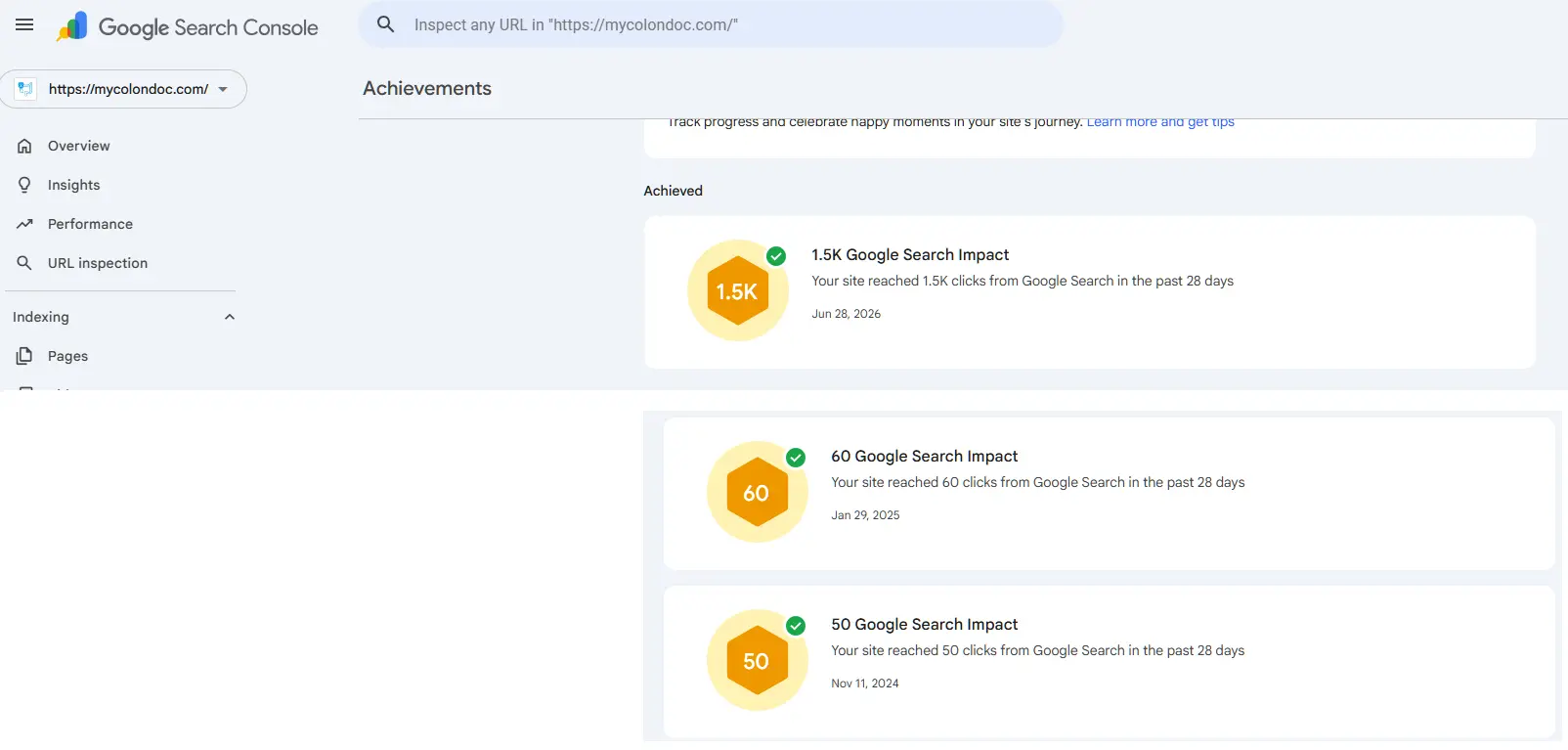
On June 28, 2026, Google Search Console confirmed that MyColonDoc.com had reached 1.5K clicks from Google Search in the previous 28 days.
Compared with the historical benchmark of 60 clicks, the 1.5K milestone represented:
- 25 times the historical Google Search traffic
- Approximately 2,400% growth over the 60-click benchmark
- 1,440 additional Google Search clicks in a rolling 28-day period
These figures came directly from Google Search Console rather than a third-party traffic estimate.
SEO Platform Data at the June 2026 Milestone #
Third-party SEO platforms use their own databases and estimation methods, so their figures do not always match Google Search Console. They remain useful for evaluating keyword coverage, authority, backlinks, and competitive visibility.
Semrush data recorded around the 1.5K milestone showed:
- Authority Score: 12
- Estimated organic traffic: 5.9K
- Estimated organic traffic growth: +3,586%
- Organic keywords: 2.3K
- Organic keyword growth: +121%
- Referring domains: 146
- Backlinks: 575
- Paid traffic: 0
- Paid keywords: 0
Ahrefs data recorded around the same milestone showed:
- Estimated organic traffic: 5.2K
- Organic keywords: 521
- Top 3 keywords: 217
- Backlinks: 408
- Referring domains: 279
- Estimated organic traffic value: $1.2K
- Paid traffic: 0
The estimates differed between platforms, but both indicated substantial improvement in organic visibility, keyword coverage, and authority.
Most importantly, the growth was achieved without paid search traffic. The website’s visibility improved through technical optimization, content development, internal linking, local relevance, and authority building.
AI Search Visibility at the June 2026 Milestone #
Search behavior is changing. Patients are no longer using only traditional Google results. They also use AI Overviews, AI Mode, ChatGPT, Gemini, Perplexity, Copilot, and other answer engines to research symptoms and possible care options.
At the June 2026 milestone, MyColonDoc had established measurable AI-search visibility:
- AI Visibility: 15
- AI Mentions: 5
- Cited Pages: 113
- Google AI Overview mentions: 4
- AI Mode mentions: 1
- ChatGPT cited pages: 19
- AI Overview cited pages: 85
- AI Mode cited pages: 19
- Gemini cited pages: 1
These measurements showed that the website was beginning to participate in AI-assisted discovery pathways as well as traditional organic search.
For a medical practice, this matters because patients may ask an AI system a symptom-based or condition-based question before deciding which physician or specialist to contact.
Why This Growth Matters for a Medical Practice #
Traffic alone is not enough for a doctor’s website. The traffic must come from relevant searches and help patients move toward trustworthy information and appropriate care.
MyColonDoc’s growth occurred across clinically relevant areas such as:
- Colorectal symptoms
- Hemorrhoid-related questions and treatment searches
- Rectal bleeding searches
- Anal fissure searches
- Anal abscess and fistula searches
- Constipation and pelvic floor concerns
- Colon and rectal cancer questions
- Colonoscopy and colorectal screening
- Proctology and colorectal surgeon searches
- Local searches for specialist care in the Phoenix area
This type of visibility is more valuable than unrelated traffic because it connects the practice with people already seeking education, evaluation, treatment options, or specialist care.
Baseline and 1.5K Milestone Snapshot #
| Metric | Baseline | June 2026 milestone |
|---|---|---|
| Google Search clicks in 28 days | Historical benchmark: 60 | 1.5K |
| Weekly sessions | 56 | Strong organic growth established |
| Estimated organic traffic | 900 | 5.2K–5.9K |
| Organic keywords | Limited | 521–2.3K |
| Top 3 keywords | Minimal | 217 |
| Valid referring domains | 2 | 146–279 reported by SEO platforms |
| Backlinks | 2 valid | 408–575 reported by SEO platforms |
| Blog articles | 0 | Content strategy active |
| AI visibility | Not established | 15 |
| AI cited pages | Not established | 113 |
| Paid search traffic | 0 | 0 |
Google Search Console provides the first-party click measurement. Semrush and Ahrefs figures are third-party estimates and may differ because each platform uses a separate methodology.
Key Lessons From the Initial Growth Stage #
The MyColonDoc growth pattern showed that medical SEO works best when it is treated as an integrated system.
A successful medical website needs more than a modern visual design. It requires:
- Strong technical infrastructure
- Clear and medically relevant content
- Patient-intent keyword targeting
- Structured internal linking
- Local search optimization
- Strong physician credibility signals
- Backlink and authority development
- AI-search readiness
- Conversion tracking
- Ongoing performance monitoring
The results also demonstrated that organic growth can reduce dependence on paid advertising. In this case, search visibility increased substantially while paid search traffic remained at zero.
Continued Growth After the 1.5K Milestone #
The 1.5K achievement was only the beginning of MyColonDoc’s accelerated organic growth.
Google Search Console subsequently recorded:
- 3K clicks in 28 days: July 9, 2026
- 5K clicks in 28 days: July 18, 2026
- 10K clicks in 28 days: August 22, 2026
- 11K clicks in 28 days: September 2, 2026
Continue through the documented growth series:
- From 1.5K to 3K Google Search Clicks
- From 3K to 5K Google Search Clicks
- Reaching 10K and Continuing Beyond 11K Google Search Clicks
These later milestones demonstrate that the original 1.5K result was not an isolated increase. It became the foundation for continued organic growth.
Conclusion #
MyColonDoc.com demonstrates how a specialty medical website can grow when technical SEO, patient-intent content, local visibility, physician authority, internal linking, analytics, and AI-search readiness are managed together.
By June 28, 2026, the website had progressed from a historical benchmark of 60 Google Search clicks to 1.5K clicks in a rolling 28-day period. The website also developed broader keyword coverage, stronger authority signals, and measurable visibility across AI-assisted search platforms.
For medical practices, the case study reinforces an important point: a doctor’s website should not function as a static online brochure. It should operate as a patient discovery, education, and acquisition system that helps people find relevant information, understand the physician’s expertise, and take the next step toward care.
Need Similar Growth for Your Medical Practice? #
AbiTechTure helps doctors, surgeons, clinics, and specialty practices build stronger websites, improve Google visibility, and develop sustainable digital growth systems.
Our approach combines enterprise-grade website architecture, technical SEO, patient-intent content, local search optimization, physician authority, AI-search readiness, analytics, and conversion improvement.
If your medical website is not generating enough relevant search visibility, patient inquiries, or appointment opportunities, begin with a structured website and SEO assessment.
Contact AbiTechTure:
Email: info@abitechture.com
Website: abitechture.com